
In the European market, the customer does not just buy furniture, but the quality of sleep and spinal health. For a dealer, the ability to argue the difference between filling types represents a transition from price competition to competition based on expertise. Understanding the physics of materials minimizes the risks of filling sagging and guarantees the return of a loyal customer. Let's look at the constructive solutions that form the added value of your assortment.
Key Filling Characteristics
• Pocket Spring. Independent spring block (256–320 springs/$m^2$). Provides point support for the spine and eliminates the "hammock effect."
• Zig-Zag Spring. The basis for softness and shock absorption. Used in sofas designed for lounging.
• Polyurethane Foam (PPU). Optimal density for daily use — from 28 kg/$m^3$ (HR or EL grades).
• Slats. Birch or beech segments with a pitch of 25–45 mm for natural mattress ventilation and enhancement of the orthopedic effect.
• Service Life. Professional layering of materials guarantees the preservation of the product's geometry for 8–10 years of daily loads.
Main Architectural Elements of Upholstered Furniture
1. Spring Systems: Pocket Spring or "Zig-Zag"
In the production of modern models, a sofa manufacturer usually chooses between two comfort concepts:
- Pocket Spring. Each spring is in a separate textile cover. This negates the transfer of vibrations — if one person stands up, the other does not feel the movement. For the B2B segment, this is an ideal argument for selling sofas with a daily sleep function.
- Zig-Zag Spring. Made of high-carbon steel. It provides elasticity to the base. Combined with multi-layered PPU, it creates a "sinking" effect, which is valued in designer models for living rooms.
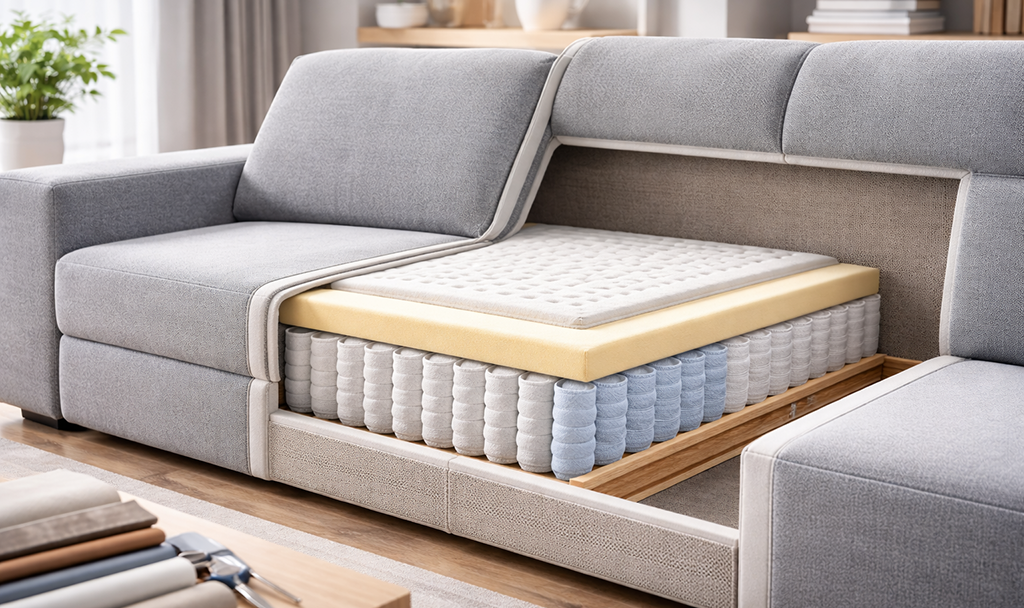
Why is this profitable for the seller? Offering Pocket Spring allows you to satisfy the customer's need for "orthopedic properties" without the necessity of buying a separate mattress. This increases the average check by 15–20% compared to dependent blocks like Bonnel.
2. Slat Base: Flexibility and Ventilation
High-quality furniture from a manufacturer must take product hygiene into account. Slats made of bent-glued birch perform two functions:
- Shock Absorption. They take on part of the vertical load, extending the lifespan of the spring block.
- Aeration. The free space between the slats ensures air circulation, which is critical for preventing moisture accumulation inside the filling.

Technical Tip. For the EU market, the standard is the use of slats 53 mm wide with attachment in rubber holders, which eliminates the appearance of squeaking.
Secrets of Layering: PPU and Sandwich Technologies
When you order upholstered furniture wholesale, pay attention to the density of the polyurethane foam. We use HR (High Resilience) and EL (Extra Lay) markings.
- Density. The main indicator. PPU with a density of 22 kg/$m^3$ is suitable only for backrests. For the seat, the professional standard is 28–40 kg/$m^3$.
- Firmness. Combining a firm base layer and a soft top layer (for example, with the addition of latex or Memory Foam) creates that same "cloud" effect while maintaining correct body support.
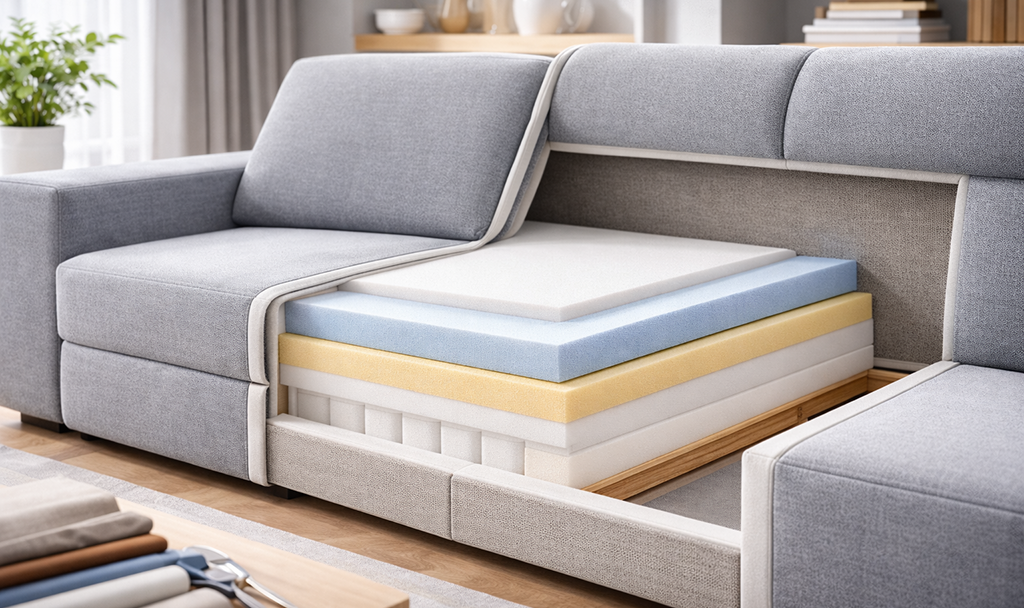
B2B Benefit. Using high-density PPU drastically reduces the number of claims due to seat "sagging." The seller can confidently provide an extended warranty on the filler, which is a significant factor of trust for the end buyer.
Ergonomics and Durability
Filling quality is closely linked to sofa mechanisms. If the transformation mechanism is designed for 15,000 cycles, the filler must also maintain its elasticity for a similar period.
We integrate layers of thermo-felt between the springs and soft layers. This technical solution prevents metal from rubbing against the foam, increasing the product's lifespan by 30%. When tested using the Martindale method (though it is more often applied to fabrics), the internal components of our sofas demonstrate resistance to intense dynamic loads, meeting commercial standards for use in hotels and public spaces.
Conclusion. Expertise as a Scaling Tool
Understanding the difference between a spring block (Pocket Spring), "zig-zag" springs, slats, and polyurethane foam (PPU) of different densities allows your staff to move from describing appearance to analyzing structural reliability. This forms the image of your store as a professional salon where the customer's health is valued.
Would you like to receive technical specifications of our top models for training your staff? Contact us, and we will send a full package of marketing materials for your showroom.


